She could not have been twenty-five. She was working the bar alone on a slow evening, brown-skinned, close-cropped, and when I asked for a cocktail she told me the truth.
I don't know how to make cocktails. I can pour you something simple.
I want you to understand how uncommon that is. Almost anyone else would have bluffed. Reached for a shaker, thrown something together with confidence, and served me a bad drink with a straight face — because the performance of competence is the coin of the realm and we have all been trained to spend it. She declined to. She simply told me what she did not know.
So I said: would you like me to show you?
And she said yes, and she meant it.
We started with the distinction, because everything else follows from it. A gin martini and a vodka martini are not variations on a theme; they are different arguments. Gin has weight. Gin is juniper and coriander and angelica and orris root — it is botanical, it is structured, it is made of things that grew, and it tastes like a place. Vodka is the opposite proposition: purity, absence, the erasure of everything but cold and clarity. The Anglo world took the gin and made a ritual of it. The Slavic and the Nordic world took the vodka and made a discipline. Two entirely different theories of what a drink is for.
She listened the way people listen when nobody has bothered to explain anything to them in a long time.
Then the technique. Do not shake it. Shaking is violence — it is fast and efficient and it looks like competence, and it will get you a cold drink in nine seconds. But it aerates. It bruises. It fractures the ice and floods the glass with shards and cloud, and what you get is something thin and pretty and gone. You do not thrash gin. You turn it.
Stir. Slowly. Longer than you think. Thirty seconds, forty, until the mixing glass frosts under your hand and you feel the cold come down through the metal into your palm. You are not mixing. You are waiting. The dilution is not an accident you are trying to minimize — the dilution is the drink. Water is an ingredient. The cold is an ingredient. The time is an ingredient.
Blend, and then hold.
"You are not mixing. You are waiting. The dilution is not an accident. The dilution is the drink."
We talked about food while she practiced. I told her a little about the years I spent around it — the kitchens, the sourcing, the people whose names she would know if I said them. She wanted to know everything. What else was there to learn, what else had I been shown, what did the old ones do differently.
And somewhere in it, I mentioned an ex-girlfriend. Not as a disclosure. I did not announce anything or make it an occasion. I told a story about my life in which a woman I had loved appeared, the way people you have loved appear in stories about your life.
Her shoulders came down.
You could see it happen — a half inch she had been holding since I sat down, and had probably been holding for the whole shift, and possibly for years. She had been warm with me from the first minute. That was never the question. What she had been doing was holding something back, in the way that costs nothing visible and costs everything.
After that she talked. About being brown in Spain. About the way a room recalculates when she walks into it. About the daily arithmetic of colorism here, which is not the American kind — it is quieter, it is folded into pleasantries, it does not announce itself and therefore cannot be named. She told me she missed Portugal. She said it plainly, the way you say a thing you have said to yourself many times and to no one else.
I listened, and I did not pretend to share it, because I do not. My passport is a kind of armor. Being American lets me walk past a great deal she cannot walk past, and I would be lying to her and to you if I claimed otherwise.
But I am not exempt. What lands on me is the other one — the assumption, so common here that I have stopped being surprised by it, that a woman ought to be poorer than the man beside her. And less intelligent. That her being either of those things in reverse is a misconfiguration requiring correction. I have watched men take in the information that I earn my own money and think my own thoughts, and I have watched something behind their eyes decide it is a problem to be solved.
So there we were. Two women at a bar in a country neither of us was from, comparing the precise shape of our respective clenches.
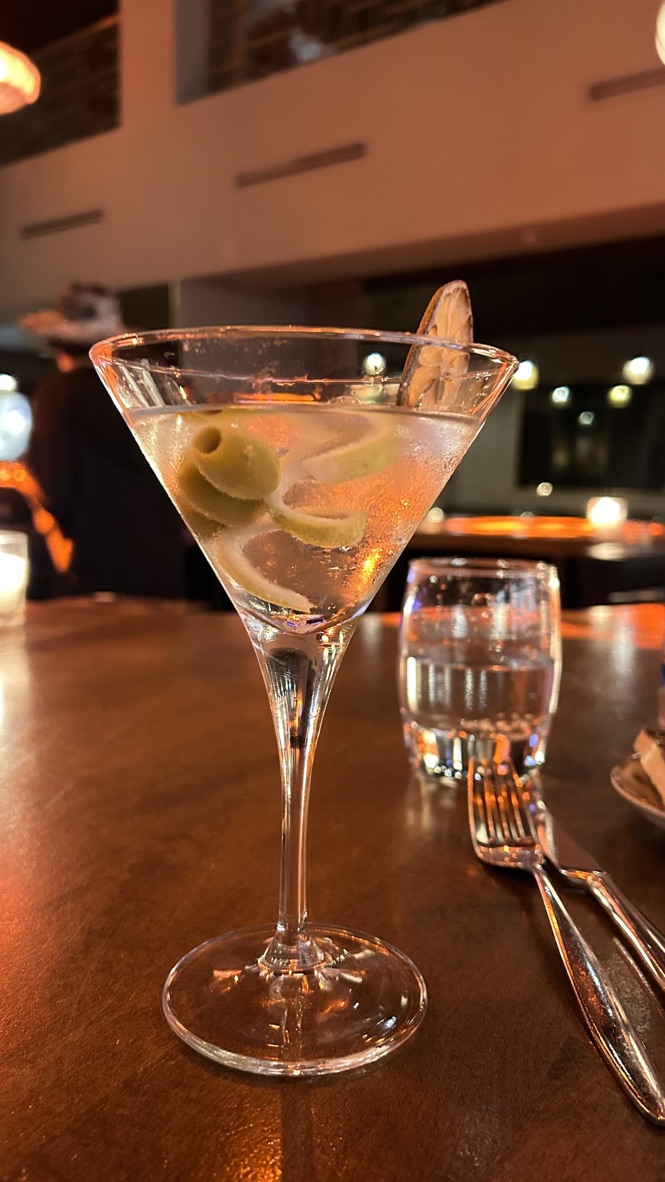
Stirred. Never shaken.
She was going off shift when she delivered the line I have not stopped thinking about since. She leaned in, entirely at ease now, and said —
"Don't let them know you used to work with culinary legends. See what the boys will do."
She was joking. She was also not joking, and we both knew it, and the joke was the safest place to put the thing we both knew.
I walked home and understood that I had spent an evening teaching a twenty-five-year-old bartender the lesson it took me two decades and an entire book to learn.
Not the one about the gin.
The one about the holding.
Some years ago I wrote a book called A Recipe for Pleasure. I wrote it under a different name, in a different life, and it did a thing I am still proud of: it went recipe by recipe through a woman's history — the men, the meals, the entanglements, the late nineties, the whole complicated business of being a Black woman who was told that her appetite was the problem — and it insisted, at every turn, that taste was the way back. That she could find her worth through her senses. That the mouth knew things the mind had been trained to deny.
I believed that. I still do. It is the truest instinct I have ever followed.
But I got one thing wrong, and I have had years to sit with the error.
I wrote that book as a journey. A path out. Recipe by recipe, step by step, toward freedom — toward some clearing on the far side where the fully expressed woman would finally be standing, having arrived. I was writing a map. I thought pleasure was the destination. I thought that if I followed the flavors far enough, they would deliver me somewhere, and then I would be healed, and then I would be allowed to enjoy things.
That is what I did not know: that honoring the senses is the healing. Not the evidence of it. Not the reward at the end of it. The thing itself.
There is no clearing.
There is no arrival, no ceremony, no moment when someone tells you that you have suffered enough and may now be permitted to taste your food.
The softening is not what comes after the work. The softening is the work.
I was a woman who could describe pleasure with tremendous precision and could not, in any sustained way, sit inside it. I could tell you the difference between the gin and the vermouth. I could source, plate, pour, host, curate — I could build the whole room. What I could not do was stay in it.
Because staying requires something the recipe cannot give you. Staying requires that you stop earning. And I had built an entire life, a good and impressive and hard-won life, on the conviction that the pleasure was owed to me only after the labor was accepted.
This is the difference between a person who enjoys things and a sensualist.
A sensualist is not someone who indulges. That is the cheap reading and it is why the word makes people nervous — they hear appetite, they hear excess, they hear a woman with no brakes. Wrong. A sensualist is someone who has decided that the sensory world is not decoration on top of the real life, but is the real life. That the fig, the salt, the cold of the metal against the palm, the forty seconds, the weight of the glass, the person across the table — that all of this is not the reward for existence. It is the content of it.
And that requires discipline, not license. It requires that you slow down enough to be present in your own mouth. Anyone can drink a martini. Very few people can stand still for the forty seconds it takes to make one correctly, because those forty seconds are unbearable to a woman who has been taught that her value is in her motion.
Blending is easy. Anyone can blend. The holding is the whole practice.
What I know now — what the woman who wrote that book had not yet lived long enough to know — is that I was never going to think my way into being free. There was no insight waiting at the end of the journey. There was only this: the slow, ordinary, unglamorous work of letting my own senses tell me the truth, and then not arguing with them.
Softening is not weakness and it is not surrender. It is the hardest thing I have ever done, and I do it daily, and I am not finished. Some mornings I still catch myself running the calculation — what did I do to deserve this coffee, this light, this hour — and I have to put the calculator down and simply taste what is in front of me.
That is life as me. Not life as the woman who earned it. Life as me.
She had asked me, before all of it, how long it takes to get good at this.
I told her the truth. Longer than you want. And the day you finally stop rushing is the day it starts tasting like something.
A Classic Martini
Stirred · Never shaken · One drink
- 2½ oz London dry gin
- ½ oz dry vermouth
- Cracked ice, generous
- A wide strip of lemon peel
- Or one good olive. Not three.
- A coupe, in the freezer, since yesterday
- Chill the glass first. Everything after this depends on it.
- Gin and vermouth into a mixing glass. Fill it properly with ice — a mean pour of ice melts fast and ruins you.
- Stir. Thirty to forty seconds. Do not stop early. The glass will frost and you will feel the cold arrive in your hand; wait until you do.
- Strain into the chilled coupe.
- Express the peel over the surface — you should see the oil catch the light — then run it around the rim and drop it in.
- Do not carry it anywhere. Drink it where you made it, standing up if you like, before it warms.
The vermouth is not optional and the ratio is not a personality test. Dilution is not the enemy of the drink; it is the drink. What you are making, for forty seconds, is time.