We started the call talking about pleasure and ended up somewhere else entirely. That is what always happens when two women who have actually lived their lives sit down together without an agenda. The conversation goes where it needs to go. I have stopped apologizing for that. The wandering is not a failure of focus — it is focus, operating at the level where the real material lives.
Dejah and I were supposed to be talking about pleasure for this issue. We did. We just took the long way around. We went through fear first, as you have to — because the two are not opposites so much as they are neighbors, separated by the thinnest wall. You cannot locate one without brushing up against the other. And what became clear to me over the course of our conversation was something I had understood in my body long before I had the words for it: that those who have suffered most completely are the ones who know bliss most precisely. The depth of the wound tells you the height of the healing. But what no one talks about is what lives between them. That in-between place — after the suffering, before the bliss — is where fear takes up residence. And fear, left unexamined, will kill everything.
"You cannot locate pleasure without brushing up against fear. The two are not opposites — they are neighbors, separated by the thinnest wall."
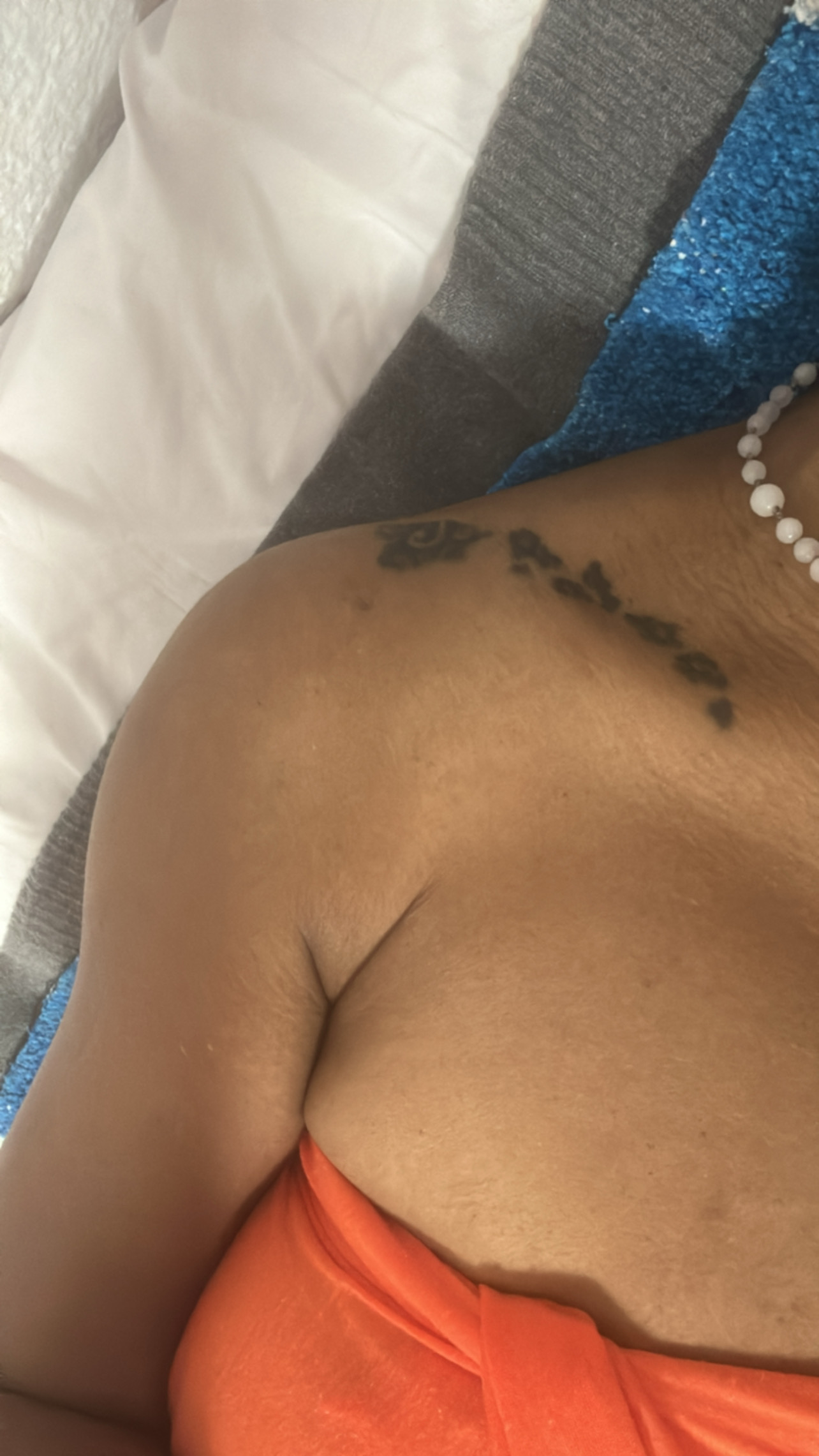
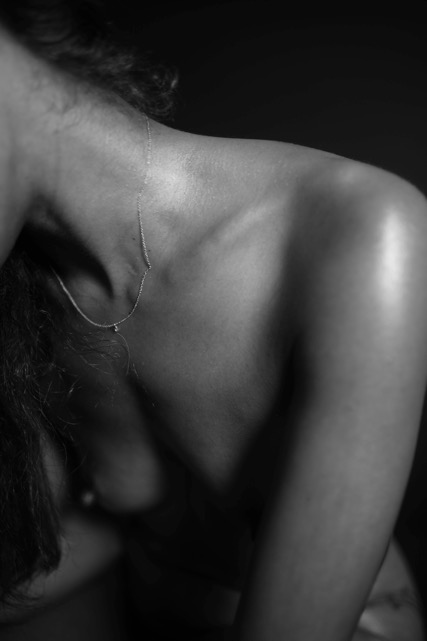
Aurèlin Sainté LysI know what fear looks like in the body because I have watched it accumulate in mine over years. A photographer once stopped me mid-shoot in Mumbai. She said, you're shrinking yourself. I said, what do you mean? She said, look at your neck. I looked. I had been drawing it in — shortening it, pulling it down into my collarbone — the way you do when you are trying to make yourself smaller than the space you are actually entitled to occupy. The wild part was that I hadn't felt it. That was the lesson. Fear doesn't always announce itself. Sometimes it just quietly rewires your posture, your gait, the way you hold your shoulders in a room. I think of my aunties — all of them, in their various ages and stages — and I can see it in their bodies too. The shortened necks. The raised shoulders. The muscled-down stance of women who learned, early and repeatedly, that taking up space had consequences. We call it strength. We call it resilience. What we don't call it, because naming it would require us to do something about it, is fear.
Aurèlin Sainté Lys
Dejah Gomez
Dejah said something that stopped me. She was talking about pleasure — about what it means to actually measure it, to know it in the body — and she said that as a 19-year-old she thought she understood pleasure. She was having fun, she was alive in her body, she thought that was the ceiling. Then life happened. Children. Loss. Grief. Death and rebirth. Her own. And now, she said, she could access pleasure without even touching her body. That is not a metaphor. That is a woman who has been broken open enough times to know where the light gets in.
"What's the depth of the fucking pain and suffering we've actually experienced to really know the height of true pleasure? To get to bliss, to get to that nirvana — you have to know the distance."
That distance is where the scar forms. And a scar, unlike an open wound, is not something that hurts all the time. It's something you forget about, mostly — until you press on it. Until life asks you to expand into the very territory where you were once diminished, and your body, which remembers everything, pulls back. Raises its shoulders. Shortens its neck. Says: not here. Not this. We tried this before.
This is the particular cruelty of pleasure for women who have come through something. The very thing you most deserve — rest, joy, desire fulfilled, the slow uncoiling of yourself in a life that is finally large enough — is the thing your nervous system flags as dangerous. Because the last time you reached for it, something took it from you. Or you took it from yourself, because someone taught you that wanting too much was its own kind of sin.
We talked about how Power as an issue came together almost effortlessly. I sent emails, contributors delivered, the pieces arrived. I did not understand why until Dejah said it plainly: Power lives in the masculine, and we are all so conditioned around the masculine that it was easy. Pleasure lives in the feminine — in receptivity, in softness, in the willingness to receive without immediately converting the gift into productivity — and we have such a fraught relationship with that. Of course it was harder. Of course people were late. Of course I found myself pulling the issue into existence by sheer force of will, which is the most un-pleasurable way to make anything.
We have been taught that suffering is honorable. That struggle is proof of seriousness. That the harder something was to achieve, the more it is worth. We beat our chests over what cost us. We are suspicious of what came easily. We have built an entire value system around difficulty — and then we wonder why pleasure, which by definition requires us to stop striving, feels so illegitimate.
Receptivity is power. I know this. I have known it theoretically for years. What our conversation gave me was the embodied version of that knowing — the felt sense of how much of what we call strength is actually armor, and how much of what we dismiss as softness is actually the thing that will finally let us arrive somewhere worth arriving.
"Spirit reminds us that we are the currency. When we are in our joy, the currency flows — effortlessly."
Dejah GomezDejah said: spirit reminds us that we are the currency. When we are in our joy, the currency flows effortlessly. It is not a striving, it is not a struggle. You are the joy. And I heard it the way you hear something you already know but have been too afraid to act on — with a kind of recognition that is almost grief, because of how long you waited to let it be true for you.
The fear that stands between a woman and her pleasure is not irrational. It is the accumulation of every time she reached for something beautiful and was told she had misread the room. Every time desire was weaponized against her. Every time softness was taken for weakness and weakness was punished. The scar is real. The body that guards it is doing its job. The work — the actual work, not the kind we are praised for — is in teaching that body that the danger has passed. That this moment, this life, is different. That you are allowed to arrive.
Fear will kill everything. It will kill the conversation before it begins, the desire before it is spoken, the pleasure before you have let yourself believe you deserve it. I have watched it do this. I have done it to myself. The antidote is not courage in the dramatic sense — it is not the bravery of the battlefield, which is another masculine construction. The antidote is the quieter, more radical act of remaining open in the face of everything that has taught you to close. Of choosing, daily, to be in your body without bracing for impact. Of allowing the good thing to be good without immediately calculating what it will cost you.
That night, talking to Dejah at midnight across time zones, going everywhere and nowhere, I felt it. Not the idea of pleasure. The thing itself. Two women, present with each other, saying the true thing. Nothing to perform. Nothing to prove. The conversation moving the way water moves — finding its own level, arriving where it needed to arrive.
That is what bliss looks like when fear is not running the room. It looks like this. Like two women, talking at midnight, finally putting something down.
The feminine act of resistance is not protest.
It is not armor. It is not strategy.
It is the willingness to be in pleasure
when everything in your history says
you shouldn't be.
That is the whole argument.